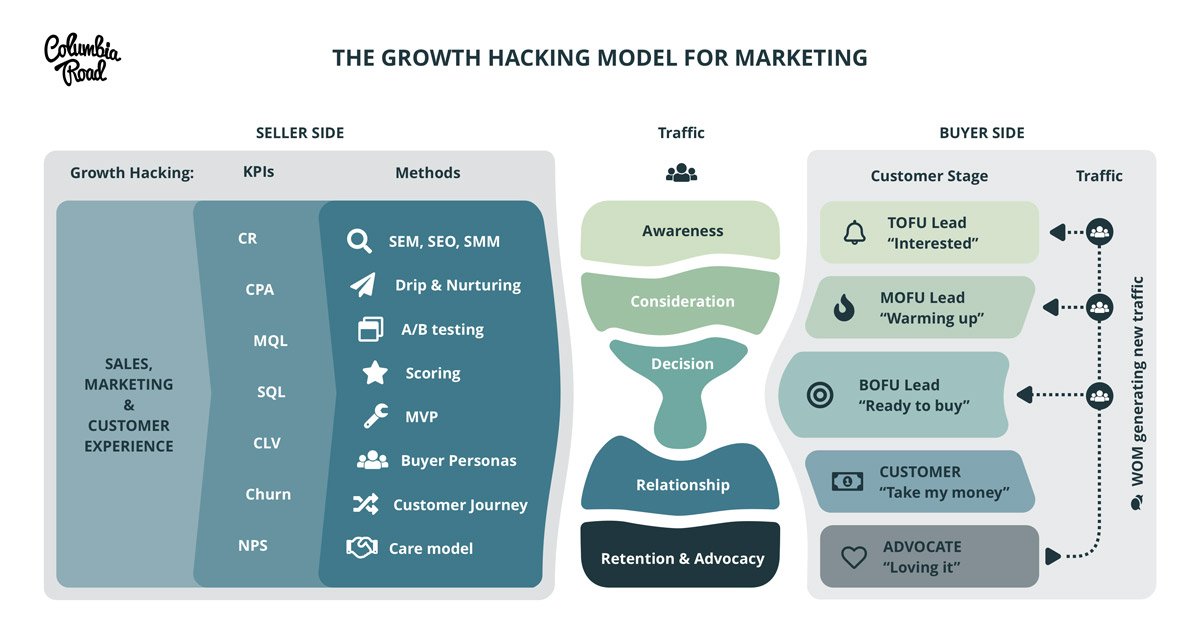
The world of business today moves at warp speed. To keep pace, traditional marketing tactics often aren't enough to secure rapid, scalable expansion. This is where Marketing & Growth Hacking storms onto the scene, offering a dynamic, data-driven approach designed to propel your business into hyper-growth mode. It’s less about massive budgets and long-winded campaigns, and more about smart experiments, swift iterations, and laser-focused results that help you stand out in a crowded digital landscape.
At a Glance: What You’ll Discover About Marketing & Growth Hacking
- Growth Hacking Defined: A data-driven, fast-paced marketing approach prioritizing rapid, scalable business growth through continuous experimentation.
- Key Differentiator: Focuses on efficiency, low-cost tactics, and measurable results, unlike traditional marketing's broader brand awareness goals.
- Strategic Frameworks: Leverage models like AARRR (Pirate Funnel), Growth Loops, North Star Metric (NSM), and ICE Scoring for structured growth.
- Tactical Toolkit: Explore 22 proven strategies, from viral loops and content marketing to A/B testing and product-led growth.
- The Mindset: A relentless, cross-disciplinary focus on growth, fueled by data, creativity, and a willingness to iterate.
- Practical Application: Learn how to identify bottlenecks, prioritize tactics, and execute experiments for maximum impact.
Unpacking the Buzz: What Exactly Is Growth Hacking, Anyway?
Forget everything you thought you knew about marketing. Growth hacking isn't just a trend; it's a fundamental shift in how businesses approach market saturation and user acquisition. At its core, growth hacking is a scientific, data-driven, and intensely creative process centered on achieving rapid, scalable growth. It’s a marketing methodology born out of the startup world, where resources are often tight, and the need for explosive growth is paramount.
Imagine marketing, technology, and creativity merging into a single, unstoppable force. That's growth hacking. Instead of lengthy planning cycles, growth hackers prioritize rapid experimentation and efficiency. Their singular obsession? Finding ingenious, often low-cost ways to attract traffic, convert leads, and generate revenue – often in surprisingly short timeframes.
Growth Hacking vs. Traditional Marketing: A Tale of Two Philosophies
The distinction between growth hacking and traditional marketing isn't just semantic; it’s a difference in DNA. Traditional marketing often plays the long game, focusing on brand awareness, market positioning, and meticulously planned campaigns over extended periods, typically backed by larger budgets. Think glossy ad campaigns, multi-channel brand building, and a steady, predictable pace.
Growth hacking, on the other hand, is the agile, sprint-focused counterpart. It’s relentlessly analytical, driven by hard data, and obsessed with measurable outcomes. Born from the lean constraints of startups, it prioritizes rapid user acquisition and retention. Every action is an experiment, measured against a "one metric that matters" for its current growth stage. While traditional marketing asks, "How can we build our brand?" growth hacking constantly probes, "How can we grow right now?"
The Growth Hacker Mindset: Your North Star to Success
Becoming adept at growth hacking isn't just about mastering a set of tools or tactics; it's about adopting a particular way of thinking. The growth hacker's "true north" is always, unequivocally, growth. This isn't just a slogan; it's the guiding principle that informs every decision and every experiment.
A growth hacker operates with several key tenets:
- Data-Driven Decisions: Intuition is a starting point, but data is the ultimate arbiter. Every hypothesis is tested, every result analyzed, and every decision is based on quantifiable evidence.
- Creativity and Resourcefulness: With often limited budgets, growth hackers excel at finding unconventional, low-cost methods to achieve outsized results. They're constantly looking for overlooked opportunities and innovative solutions.
- Agility and Experimentation: The mantra is "test, learn, iterate." They're comfortable with ambiguity, quick to pivot, and always running small, controlled experiments to discover what truly moves the needle.
- Cross-Disciplinary Collaboration: Growth doesn't happen in a silo. A growth hacker bridges marketing, product development, engineering, and analytics, understanding that these functions must work in concert.
- Product-Oriented Thinking: They see the product itself as a powerful growth engine, embedding virality and retention mechanisms directly into the user experience.
This mindset fosters continuous improvement and optimization, transforming marketing into a dynamic, scientific pursuit.
Building Your Growth Engine: Core Frameworks for Strategic Thinking
Effective growth hacking isn't random; it's highly structured. These foundational models provide the strategic blueprints for understanding your customer journey and prioritizing your efforts.
The AARRR Funnel (Pirate Funnel): Mapping the Customer Journey
Developed by venture capitalist Dave McClure, the AARRR funnel (Acquisition, Activation, Retention, Referral, Revenue) provides a simple, yet powerful, framework for analyzing how users interact with your product or service. Think of it as a roadmap for optimizing each stage of the customer lifecycle:
- Acquisition: How do users discover you? This is where you cast your net—website visits, social media impressions, ad clicks.
- Activation: Once acquired, do they have their "aha!" moment? This is about getting users to experience the core value quickly, like completing onboarding or making a first meaningful interaction.
- Retention: Are they coming back? Keeping users engaged and preventing churn is critical for long-term growth.
- Referral: Do they tell others? Encouraging existing users to invite new ones creates powerful organic growth.
- Revenue: Are they paying you? This is where usage translates into sustainable income, through subscriptions, purchases, or other monetization strategies.
By examining each stage, you can pinpoint bottlenecks and target your growth hacking efforts precisely where they'll have the most impact.
Growth Loops: The Engine of Compound Growth
Beyond linear funnels, growth loops represent self-reinforcing cycles where each new user or action inherently brings in more users. Unlike a funnel that ends with a purchase, a loop continuously generates new inputs.
Consider a referral program: an existing user refers a friend (new user), who then uses the product, loves it, and refers their friends. This creates a compounding effect, where initial efforts keep paying dividends. Examples include user-generated content platforms (more users create more content, attracting more users), or viral sharing features built directly into a product. Growth loops are powerful because they reduce your reliance on costly external acquisition channels over time.
The North Star Metric (NSM): Your Guiding Light
In the whirlwind of data, a North Star Metric (NSM) provides clarity. It's a single, overarching metric that best represents the core value your product delivers to customers and aligns every team within the company towards a common goal. For a social media platform, it might be "daily active users." For a streaming service, "total hours of content consumed."
The NSM isn't just a vanity metric; it directly correlates with sustainable business growth. By focusing on one key metric, teams avoid distraction and can prioritize experiments that truly move the needle on what matters most.
ICE Scoring: Prioritizing Your Experiments
With endless ideas for growth, how do you decide what to tackle first? ICE Scoring (Impact, Confidence, Ease) is a simple prioritization framework. For each potential growth experiment, you score it on three factors:
- Impact: How big of a positive change do you expect if this experiment succeeds? (e.g., on a scale of 1-10)
- Confidence: How certain are you that this experiment will actually work as hypothesized? (e.g., on a scale of 1-10)
- Ease: How simple or complex is it to implement this experiment? (e.g., on a scale of 1-10, where 10 is very easy)
Multiply these scores together, and the highest-scoring ideas become your priority. This helps you focus on high-impact, achievable experiments that are likely to yield quick wins.
The Arsenal: 22 Proven Growth Hacking Strategies & Tactics
Now that we understand the mindset and frameworks, let's dive into the practical tactics. Growth hackers employ a diverse array of strategies, often combining several for maximum effect.
Digital Channel Mastery
- Search Engine Optimization (SEO): The art and science of getting your website to rank higher in search results. This involves meticulous keyword research, optimizing on-page content, building high-quality backlinks, and ensuring mobile-friendliness. The goal is to capture organic traffic actively searching for what you offer.
- Paid Advertising: Fast-track your reach by targeting specific demographics and interests through platforms like Google Ads, Facebook Ads, LinkedIn Ads, or TikTok Ads. Paid campaigns are excellent for rapid customer acquisition, lead generation, and retargeting, offering scalable growth on demand.
- Social Media Marketing: More than just posting updates, this involves engaging content, targeted ads, influencer partnerships, and community building on platforms like Instagram, Twitter, and Facebook. It builds brand identity, increases engagement, and expands your customer base.
- Email Marketing: A direct line to your audience, email remains incredibly powerful for lead nurturing, customer acquisition, re-engagement, upselling, cross-selling, and retention. Personalized campaigns can drive significant conversions.
- SMS Marketing: For immediate and direct communication, SMS is highly effective for promotional offers, timely reminders, updates, and collecting feedback. Its high open rates make it a potent tool for driving engagement and sales.
User Engagement & Retention
- A/B Testing: This is the cornerstone of data-driven optimization. Experiment with different versions of landing pages, email subject lines, ad creatives, or product features to see which performs better. A/B testing helps optimize user acquisition, conversions, and overall effectiveness.
- Retargeting: Ever noticed an ad for a product you just viewed online? That’s retargeting. This tactic delivers personalized ads to previous website visitors or customers, prompting them to re-engage, complete a purchase, or explore related offerings.
- User Feedback: Directly listening to your customers is invaluable. Collect insights through social listening, surveys, user testing, and feedback forms to understand needs, identify pain points, and inform product improvements and growth strategies.
- Community Building: Fostering a sense of belonging among your users through social media groups, online forums, loyalty programs, or events can dramatically increase brand loyalty, advocacy, and organic growth.
- Gamification: Injecting game-like elements (points, badges, leaderboards, levels) into your product or service can significantly boost engagement, influence user behavior, build loyalty, and even create viral loops by making interaction fun and rewarding.
- Live Video: Engaging audiences in real-time through Q&A sessions, product demonstrations, or tutorials on platforms like Instagram Live, Facebook Live, or YouTube Live builds trust, fosters loyalty, strengthens community, and extends your reach.
- Webinars: Offering educational content through webinars is a proven way to generate high-quality leads, build credibility as an industry expert, and demonstrate your product's value. The content can then be repurposed for wider reach.
Product-Led & Viral Growth
- Free Trials/Freemium Model: Offering a low-risk way for users to experience your product before committing. Free trials (time-limited) or freemium models (basic features free forever) are excellent for lead generation, increasing conversions, and gathering initial user feedback.
- Viral Loops: Designing mechanisms where users naturally invite others, leading to exponential growth. This can involve referral marketing with incentives, user-generated content that's shareable, built-in social sharing features, or gamification elements that encourage invites.
- Referral Marketing: Incentivize your existing, happy customers to spread the word. Offering rewards, discounts, or exclusive content for successful referrals turns your user base into a powerful sales force.
- Product-Led Growth Features: Bake growth mechanisms directly into your product. Think collaborative editing features that require invites, or sharing functionalities that expose new users to your product organically. This significantly reduces customer acquisition costs.
- Invite-Only Signup System: Generate exclusivity and urgency. Creating a waitlist or offering limited beta access can create significant buzz, leverage FOMO (fear of missing out), and accelerate adoption as people clamor to be part of an elite group.
Strategic Partnerships & Insights
- Influencer Marketing: Partner with individuals who have an established, engaged audience relevant to your niche. Influencers can drive brand awareness, generate user-generated content, boost referrals, and provide valuable market insights.
- Content Marketing/Hacking: Create and distribute valuable, relevant, and consistent content (blogs, videos, infographics, podcasts) to attract and retain a clearly defined audience. This drives SEO, nurtures leads, and positions you as an authority.
- Social Listening: Actively monitor online conversations across social media, forums, and review sites. This helps you identify customer needs, spot market trends, manage brand reputation, and uncover opportunities for content creation or product development.
- Collaboration Marketing/Partnerships: Team up with complementary brands or organizations. This allows you to tap into new audiences, share resources, cross-promote, and expand your reach more efficiently than going it alone.
Automation
- Automation: Streamline repetitive tasks across your marketing, sales, customer service, and lead generation funnels. From automated email sequences to social media scheduling and chatbot support, automation frees up valuable human resources and optimizes processes for efficiency and scale.
Real-World Wins: Brands That Hacked Their Way to the Top
Growth hacking isn't just for obscure startups; even giants leverage these principles. Seeing these strategies in action clarifies their power.
- Dropbox: Perhaps the quintessential example of viral growth. Their simple offer—"get extra free storage for every friend you refer"—led to explosive growth by turning every user into an advocate. This is a masterclass in Making your efforts count from existing customers.
- Airbnb: In their early days, Airbnb famously leveraged Craigslist to market their affordable accommodations, effectively tapping into a massive, pre-existing audience where their target users already congregated. This demonstrated creative resourcefulness and channel hacking.
- Hotmail: One of the earliest and most brilliant examples of a viral loop. Every email sent from Hotmail included the signature: "P.S. I love you. Get your free email at Hotmail." This turned every user into a distribution channel.
- LinkedIn: The platform encouraged users to invite their professional contacts and made user profiles public by default, which significantly boosted their SEO and visibility. This dual approach fueled both direct acquisition and organic discoverability.
- PayPal: In its infancy, PayPal literally paid users to join and refer friends, offering $10 for signing up and another $10 for each referral. While costly upfront, this rapid user acquisition strategy built critical mass needed for network effects.
- Robinhood: The investment app utilized an invite-only waitlist system. Users could jump higher in the queue by inviting friends, generating massive buzz and a substantial user base even before launch.
- TikTok: Mastered personalized content recommendations, driving an addictive user experience. Coupled with user-generated content and easy-to-use in-app creation tools, they built a powerful growth engine that continuously adapts their algorithms based on user feedback.
- Canva: Revolutionized design with a freemium model and an agile approach. Their online design tools are intuitive and accessible across platforms, and they continually integrate customer feedback for product improvements and organic, collaborative sharing features.
These examples highlight a common thread: understanding the user, finding clever distribution channels, and building virality directly into the product or service.
Crafting Your Own Growth Playbook: How to Choose & Execute
With so many tactics, how do you know where to begin? A strategic approach ensures your efforts are focused and effective.
- Start with Your Biggest Bottleneck: Analyze your AARRR funnel. Where are users dropping off? Is it acquisition, activation, or retention? Pinpoint the weakest stage and direct your initial growth hacking efforts there. Trying to optimize everything at once leads to dilution.
- Align with Your Audience's Behavior: Don't chase shiny new trends if your audience isn't there. Understand where your target users spend their time, what platforms they use, and how they prefer to interact. Pick tactics that meet them where they already congregate and align with their natural preferences.
- Prioritize by Impact and Ease (ICE Scoring): Use the ICE framework to objectively evaluate potential experiments. Focus on those that promise high impact with reasonable confidence and are relatively easy to implement. This allows for quick wins and builds momentum.
- Test Small, Learn Fast, Scale What Sticks: Growth hacking is about iteration. Don't invest heavily in an unproven idea. Run minimal viable experiments (MVEs) to test your hypotheses. Measure the results against your "one metric that matters" for that experiment, learn from the data (whether it succeeds or fails), and then iterate or scale up what proves effective.
From Marketer to Growth Hacker: Cultivating the Skills You Need
Want to join the ranks of growth hackers? It requires a unique blend of analytical rigor, creative flair, and technical savvy.
- Solid Marketing Foundation: Understand the fundamentals of branding, customer psychology, market segmentation, and strategic planning. These traditional concepts provide essential context for growth hacking.
- Master Data Analysis & Metrics: Learn how to collect, interpret, and act on data. Proficiency with tools like Google Analytics 4, Mixpanel, or Amplitude is non-negotiable for informing decisions and measuring impact.
- Stay Tech-Savvy: Keep abreast of new marketing technologies, automation tools, and analytics platforms. The digital landscape evolves rapidly, and leveraging new tech provides a competitive edge.
- Gain Basic Technical Skills: While not every growth hacker needs to be a developer, understanding the basics of HTML/CSS, and having familiarity with database queries (SQL) or scripting languages (Python) for data manipulation, can be incredibly empowering.
- Develop Problem-Solving Skills: Growth hacking is fundamentally about creative problem-solving. It requires the ability to think outside the box, identify root causes, and devise innovative solutions to complex growth challenges.
- Hands-On Experience: Theory is one thing, practice is another. Seek internships, contribute to side projects, or take on freelance work to apply your skills in real-world scenarios.
- Network & Learn Continuously: Engage with other growth hackers, join online communities, attend workshops, and stay updated with industry news and trends. The field is constantly evolving, so continuous learning is key.
- Embrace Flexibility and Adaptability: Be comfortable with rapid change, experiment often, and be willing to pivot strategies based on data.
Navigating the Toolkit: Essential Software for Growth Hackers
A growth hacker is only as effective as their tools. These categories represent the foundational software every growth hacker should be familiar with:
- Analytics and Tracking: Tools like Mixpanel, Amplitude, and Google Analytics 4 are crucial for understanding user behavior, tracking conversions, and measuring the impact of your experiments.
- A/B Testing and Experimentation: Platforms such as Optimizely, VWO, and LaunchDarkly allow you to run controlled experiments on your website, app, or marketing campaigns to optimize for specific outcomes.
- Marketing Automation and Email: HubSpot, Customer.io, Mailchimp, and Klaviyo help automate email campaigns, nurture leads, manage customer relationships, and scale personalized communication.
- SEO and Content Tools: Ahrefs and SEMrush are industry standards for keyword research, competitor analysis, backlink monitoring, and identifying content opportunities. BuzzSumo helps discover trending content.
- Collaboration and Backlog Management: Tools like Notion, Airtable, and Trello are invaluable for organizing growth experiments, tracking progress, managing tasks, and fostering cross-functional teamwork.
The Unending Journey: How Long Does Growth Hacking Take?
This isn't a sprint with a finish line; it's an ongoing marathon of continuous improvement. The duration to see significant results from growth hacking efforts varies wildly. A small business with a niche product might see rapid growth in weeks or months, while a larger, more complex organization might measure progress in years.
Key factors influencing this timeline include your business size, industry complexity, available resources, and the competitive landscape. Regardless of the timeline, growth hacking demands persistence, flexibility, and an unwavering commitment to data-driven experimentation. It's a continuous cycle of hypothesizing, testing, analyzing, and adapting—never truly "finished."
Your Next Move: Embracing the Growth Hacking Revolution
The era of guess-and-hope marketing is over. In a hyper-competitive market, Marketing & Growth Hacking provides the precision, speed, and data-backed confidence needed to not just survive, but to truly thrive. It's an exciting, challenging, and incredibly rewarding field that empowers you to unlock unprecedented levels of business growth.
Whether you're looking to redefine your company's trajectory or carve out a dynamic new career path, embracing the principles of growth hacking is your clearest route to rapid, scalable success. Start by analyzing your customer journey, identifying your biggest bottleneck, and running your first small experiment. The insights you gain will set you on a path of continuous discovery and exponential growth.